
The country's largest lender State Bank of India (SBI) will revamp its banking application (app) YONO and position it as a complete digital bank (DB) under a new rubric 'Only YONO' for enhancing customer experience and ease of use. The bank plans to bring in a consultant to help draw up the project plan, keeping in mind business goals for the next five years. With 54 million monthly active users (MAUs), SBI YONO has seen growth of over 35 per cent in MAUs in 2021.

'By integrating data, research, and new insights, we are designing work environments that foster innovation, collaboration, and wellbeing.'

The stock of United Spirits, the country's largest liquor company by market capitalisation (mcap), has gained 11 per cent over the past week on double-digit growth guidance, rising premiumisation trend, operationally in-line performance in the March (Q4FY24) quarter and a rally in consumer stocks. The revenue growth of the company came in at 7 per cent year-on-year (Y-o-Y) mirroring the growth of the prestige and above (P&A) segment. This segment comprising premium brands accounts for 88 per cent of the revenues.

Britannia Industries reported revenue growth of 4 per cent year-on-year (Y-o-Y) in Q1FY25 and volume growth of 8 per cent implying price trends were adverse. Other operating income jumped 195 per cent, due to the incentive received for the Ranjangaon plant. The non-biscuit portfolio (rusk, cake, bread) remained key to growth and contributed 25 per cent of the total revenue.

India needs to grow at an annual rate of 9-10 per cent for around three decades and constant innovations to become a $35 trillion economy by 2047, India's G-20 Sherpa and former NITI Aayog CEO Amitabh Kant said on Sunday. "We are the fifth largest economy in the world and by 2027 we will surpass Japan and Germany to become the third largest economy in the world. "And our aim is that by the time we turn 100 in 2047, India should be a $35 trillion economy," Kant said while addressing a session at Mumbai Tech Week (MTW) hosted by Tech Entrepreneurs Association Mumbai (TEAM).

Amid increasing popularity of virtual currencies in various parts of the world, the Reserve Bank of India (RBI) on Monday said it is open to exploring the possibility of a digital version of fiat currency. Host of private digital currencies, virtual currencies and cryptocurrencies have gained popularity in recent years, though Indian authorities continue to remain sceptical about them. "In India, the regulators and governments have been sceptical about these currencies and are apprehensive about the associated risks. "Nevertheless, the RBI is exploring the possibility as to whether there is a need for a digital version of fiat currency and in case there is, then how to operationalise it," the RBI said in its booklet on 'Payment Systems in India -- Journey in the Second Decade of the Millennium'.

'Traders must adopt digital payments as soon as possible within a set timeframe, as the nation is moving rapidly towards digitisation.' 'Ignoring digital systems is not an option for strengthening trade.'

The prime minister also stressed on the need to transform the landscape of Indian science, technology and innovation, as he assured that the government will ensure the 'Ease of doing Science' and effectively using information technology to reduce red tape.

Coca-Cola Company on Thursday replaced its corporate website with Coca-Cola Journey, which is a digital magazine that focuses on social causes and company news.

Households are likely to remain the primary net lenders to the economy in the coming decades.

With the recent launch of smartwatches, home-grown smartphone maker Lava is looking to secure a strong foothold in the Indian wearables market. The company aims to capture up to 20 per cent of this segment over the next few years, according to a senior executive.

Digital literacy is emerging as the professional language of 2024. It is the ability to process complex data sets, deploy critical communication technologies appropriately and validate your importance at your workplace, explains Jagdeep Kochar, managing director, Baker & Taylor India.

Modi has accelerated efforts to make India the next driver in innovation, Sunder Pichai said.

'India has undeniably become the GCC capital of the world.'

OMCs' Digital India move is likely to have an impact on more than 80.3 million Pradhan Mantri Ujjwala Yojana consumers, majority of whom are not exposed to digital transact.

Internet-based systemic wisdom connects machines and people, and will drive next-gen enterprises, said Huawei's Yatish Nagavalli.

Generative AI (GenAI) has the potential to add a cumulative $1.2-1.5 trillion to India's GDP over the next seven years, according to a report by EY. The report titled 'AIdea of India: Generative AI's potential to accelerate India's digital transformation' says that in 2029-30 alone, GenAI can contribute an additional $359-438 billion to India's GDP. The report said that around 69 per cent of the overall impact of GenAI on India's GDP is expected to be derived from sectors such as business services (including IT, legal, consulting, rental of machinery and equipment, and others), financial services, education, retail, and healthcare.

An initiative of Nandan Nilekani's EkStep Foundation, people+ai on Tuesday unveiled its vision for the future of Artificial Intelligence (AI) in India, dubbed 'Adbhut India' (Amazing India). It aims to harness AI as a powerful tool to enhance the lives of all Indians. The event marked the rollout of several initiatives by people+ai that are focused on discovering, demonstrating, and disseminating population-scale AI use cases for India.
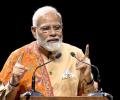
Modi said the young and aspirational India understood the need for political stability to achieve faster development and had ended three decades of instability by mere touch of a button.

The Indian IT services sector is scrambling to retain talent since digitisation-led transformation has increased the demand for a digitally skilled workforce. As a result, the pull for jobs for tech professionals is also coming from non-IT sectors, leading to higher attrition among IT companies. The average number of tech jobs from non-IT sectors has seen a 41 per cent uptick in March-May'21 versus March-May'19, according to data from Naukri.com.

The Big Four accounting firms have increased the hiring of people from technology backgrounds in India amid an increased focus of clients on digital transformation, especially after the Covid-19 pandemic. EY India said that it has expanded its overall tech talent pool by 3x in the last three years across service lines including consulting, tax, assurance, and strategy & transactions. "Today over 50 per cent of our workforce is from STEM (science, technology, engineering and mathematics) and technology background," it said, adding that it continues to hire significantly in the areas of AI, cloud computing, data analytics and cybersecurity to help its clients in transformation.


Tata Consultancy Services (TCS) announced on Tuesday that it will become the title partner of the London Marathon from 2022, following this year's race on October 3. TCS said it has signed a six--year partnership with the mass sporting event.

Industry experts believe that this deal will positively impact the Indian film industry, which is struggling with fewer movie releases.

FMCG major Hindustan Unilever on Wednesday reported a 1.53 per cent decline in consolidated net profit to Rs 2,561 crore for the fourth quarter ended March 31, 2024 due to factors such as deflation and softening of commodity prices. The company had posted a net profit of Rs 2,601 crore in the year-ago period, according to a regulatory filing from HUL. Net sales of Hindustan Unilever Ltd (HUL) were almost flat to Rs 15,013 crore in the March quarter.
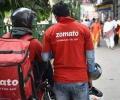
The filing of Swiggy's DRHP has led to direct comparisons with Zomato, which is a direct competitor in food delivery and the fast-growing quick-commerce segment where Blinkit (owned by Zomato) faces off against Instamart (and Zepto). In Q-commerce, Flipkart, Amazon, Reliance and Big Basket are all entering the space. All of them have deep pockets, hence competitive intensity will rise going forward.

An innovator creates intellectual property for a need no one knows exists, says Chandru Chawla.

'United Health Interface is in line with UPI. UPI is a language of money transfer, similarly, UHI is a set of protocols, which is going to create a language of health service delivery'

The World Bank on Tuesday raised the growth forecast for the Indian economy to 7 per cent for the current fiscal year on the back of recovery in agri sector and rural demand. World Bank had in June projected India to grow at 6.6 per cent for FY24. According to the World Bank Report released on Tuesday, India's growth continues to be strong despite a challenging global environment.
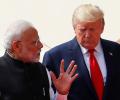
'While criticising India's high tariffs, Mr Trump stated he would impose reciprocal taxes on Indian products if re-elected.' 'However, since India's tariffs follow WTO rules, Mr Trump's actions would violate these rules,' Ajay Srivastava points out.

Global capability centres (GCCs) are increasingly looking to tap into revenue opportunities from the Indian market, which is already a critical talent hub. While capturing the potential of the Indian market has been in the works over the past few years, it's only of late that companies are gaining momentum. India is home to more than 1,580 GCCs, with a total market size of $46 billion and growing at a compound annual growth rate (CAGR) of 11.4 per cent, according to a Nasscom-Zinnov report.

World Bank president Ajay Banga is among the Indians who have made it to the prestigious Times's list of 100 most influential people in the world released on Wednesday. Time's profile of the former Mastercard CEO, written by US Treasury Secretary Janet Yellen, said, "It's not easy to find a leader with the skill and drive to take on the monumental task of transforming an essential institution, but since becoming World Bank president last June, Ajay Banga has done just that." She said Banga comes to the World Bank after leading a global organisation through which he brought millions of unbanked people into the digital economy.

Indian Institute of Management Bangalore is offering special digital courses taught by their professors.

Film folk raised Mumbai's summer temperatures even higher when they walked the red carpet at the second edition of the Bollywood Hungama's Style Icons Summit and Awards 2024 on May 2.

Can we make high speed 4G Internet available at 10 cents per GB, and make all voice calls free of cost -- that too in a large and diverse country like India? Can we make high-quality but simple breast cancer screening available to every woman, that too at the extremely affordable cost of $1 per scan? Can we make a portable, high-tech ECG machine which can provide reports immediately and that too at the cost of 8 cents a test? Can we make an eye imaging device that is portable, non-invasive and costs 3 times less that conventional devices? Can we make a robust test for mosquito-borne dengue, which can detect the disease on day 1, and that too at the cost of $2 per test? Amazingly, says Dr R A Mashelkar, the eminent scientist, all this has been achieved in India, not only by using technological innovation but also non-technological innovation.

India should not be left behind. It should join the seven central banks which are studying feasibility and safeguards necessary to eliminate risks, particularly from hacking, advises former foreign secretary Shyam Saran.

ITC Infotech looks to buy 'sub-$50 mn' firms

Compared to a 64 per cent penetration in Brazil (130 million users total) and 53 per cent in China (total 733 million users), India has barely 28 per cent penetration. Of the digital reach, almost 80 per cent are from affluent segments in urban areas. How can this change?
With NEFT, which drives the retail payments value, operationalised on a 24x7x365 basis, the country's payment systems landscape is headed for substantial growth.

'We want to play the value game for our consumers, which is health and retail will grow faster for us than the group.'
